
Hoarding is a mental health disorder
Published on 11 February 2026 10:42 AM
Following our charity's participation in Great Mental Health Day last week, our CEO, Natalie, shares one of her personal experiences with hoarding.
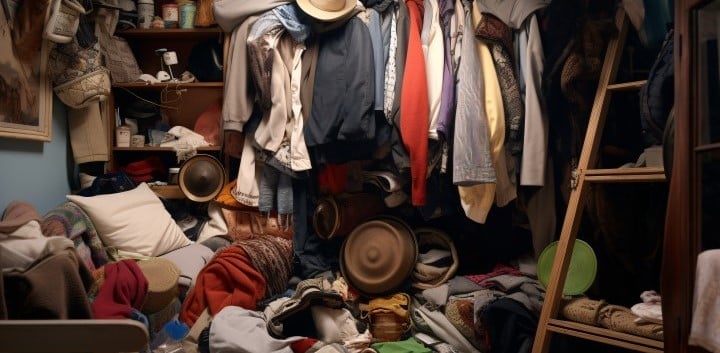
"I had two non-work encounters with hoarding last year. I'll tell you about the first case, which was with my friend's mother. Her mother was in a nursing home recovering from a fall and asked my friend to fetch some belongings from her home. She hadn't allowed my friend into her home during or since the pandemic, so my friend had a horrible surprise when she tried to open the front door and couldn't actually get any further. The hallway, and the rest of the flat, was piled with stuff from floor to ceiling, with virtually every inch of space filled. There was no space to walk; the only way to get through the flat was to climb. It was a major fire hazard, as well as a dangerous physical environment.
My friend called me for help and I went over after work with overalls, builders' gloves and surgical masks. I thought that might be overkill, but with hindsight I should have got us hair covers, shoe covers and proper respiratory dust masks as there was a severe vermin infestation too. It took us a few days working non-stop and being utterly ruthless (made significantly easier by the damage wrought by the many mice) to clear a huge chunk of a large one-bedroom flat and then, exhausted, we called in a professional company to clear the rest of the rubbish and contaminated furniture and do a deep clean.
When a path was cleared through the flat to the garden door, we found an overgrown garden full of brambles. To our dismay, there were also five big sheds filled top to bottom with more stuff, and more vermin.
Why am I sharing this story? Well, it hit me hard just how severe a mental health problem hoarding can be and how it can affect more people than just the person who is hoarding. My friend’s mother went through major grief and anger at the loss of her belongings, her privacy, her independence and her sense of identity. My friend had to overcome anxiety and overwhelm about the clearance and how her mother was going to react, along with guilt that her mother's mental health and physical well-being had deteriorated so much over the course of the pandemic and that she hadn’t been able to prevent this happening or see it coming. Me, well I was deeply saddened that a woman I'd known since I was a child who had always been so proud and independent had become so vulnerable and been reduced to living in such squalor because of a fear of scarcity. Watching my friend suffer at the same time was difficult to witness too. It had a profound impact on all three of us and 7 months on we are still processing.
What I also discovered is that there's very little practical help for the families of hoarders. I researched high and low, but found only a handful of useful contacts. In the end, we had to pay to get the help we needed to clear the home safely for my friend's mother; I appreciate not everyone is in a financial position to do this though.
The important thing to remember is that if you or someone you know has a problem with hoarding, then it’s vital to seek help for physical and mental well-being. It’s not a case of one or the other, people really do need support with both.
I hope that sharing this will help to reduce some of the shame and stigma around hoarding and encourage people to talk about it and seek help".
If you need help with hoarding, you can contact your local Council to see if they have a hoarding service and for talking therapies.
There’s also a national charity dedicated to support with hoarding: https://hoardinguk.org
For mental health support around hoarding, Mind offer some support and signposting: https://www.mind.org.uk/information-support/types-of-mental-health-problems/hoarding/useful-contacts-for-hoarding/
If you’re in Wandsworth, you can contact https://swlstg.nhs.uk/wandsworth-talking-therapies