
What Men Over 55 Need to Know About Breast Cancer
Published on 15 October 2026 07:40 AM
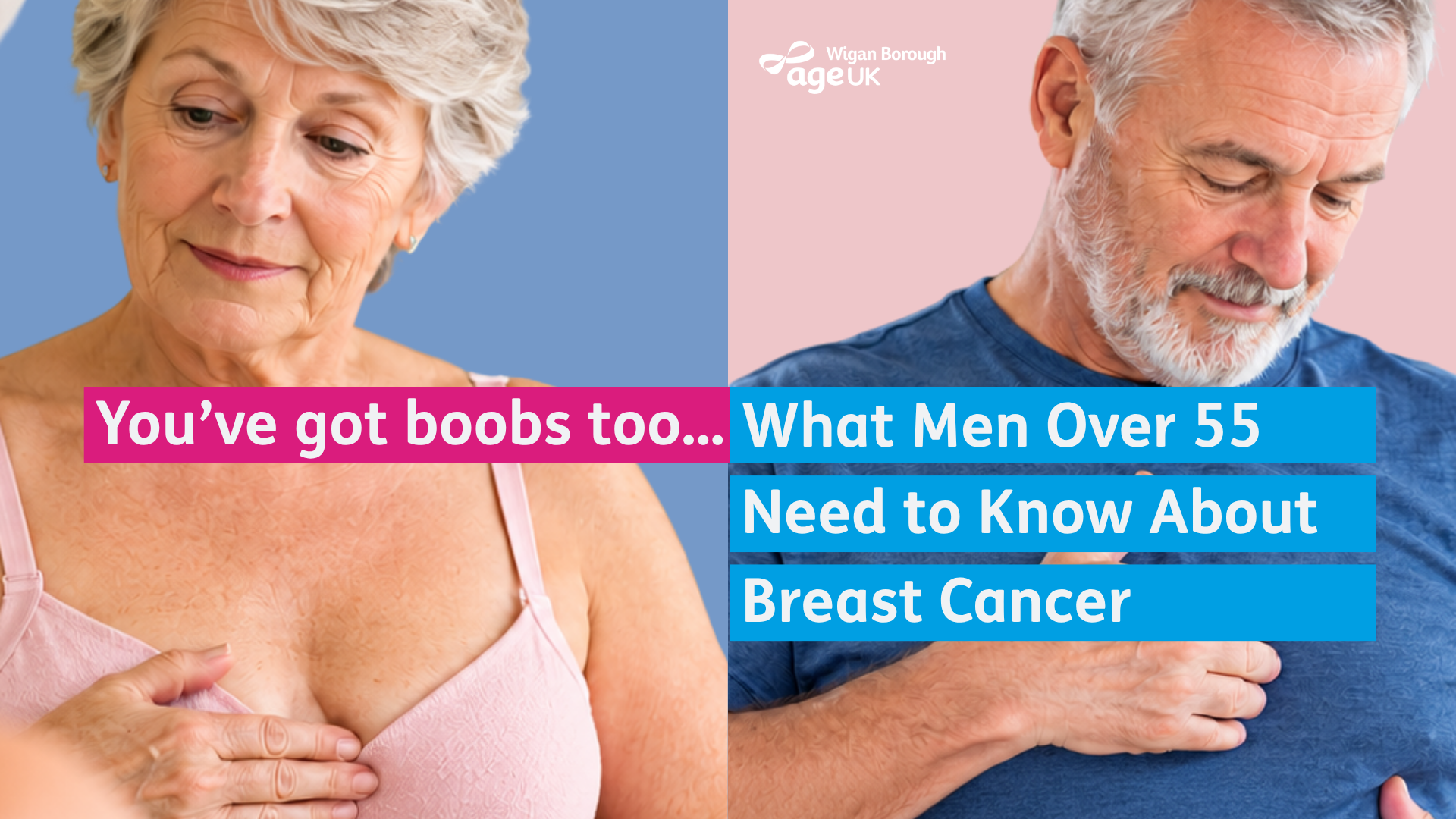
Every October, Breast Cancer Awareness Month fills our screens, shop windows and social media feeds with pink ribbons, fundraising runs and reminders to book a mammogram. It is a valuable campaign, and it has helped millions of women understand the disease and act early. But there is an important part of the conversation that is too often left out. Men can get breast cancer too.
For many men, especially those over 55, breast cancer is simply not something that seems relevant. It feels like a women's disease, and so it rarely crosses their minds. At Age UK Wigan Borough, we think that assumption needs challenging. Breast cancer in men is rare, but it is not impossible, and the men most likely to be affected are the older men in our community, the very people we work with every day.
A phrase popularised by Lucinda Light sums up the message well: "You've got boobs too." It is blunt, a little cheeky and deliberately memorable. It is also true. Anyone with breast tissue can develop breast cancer, and that includes you.
But men don't have breasts, do they?
Men do not usually develop breasts in the way women do, but everyone has breast tissue. Before puberty, boys and girls have broadly similar breast tissue. When puberty begins, hormonal changes cause female breasts to develop, while male breast tissue generally stays much smaller.
That tissue does not disappear. It is still there, particularly around and behind the nipple, and it is in this tissue that male breast cancer can develop. Cancer Research UK explains that men have breast tissue around the nipple area and can develop breast cancer, which is why men should never assume they are exempt.
Around 400 men are diagnosed with breast cancer in the UK every year, and fewer than 1 per cent of all breast cancer cases occur in men. Most men diagnosed are over 60. Rare does not mean impossible, and for the men reading this, it is worth keeping that distinction firmly in mind.
Why this matters more as we get older
Age is one of the biggest risk factors for breast cancer. Women account for the overwhelming majority of cases, but men who do develop the disease are generally older. Breast Cancer Now reports that most men diagnosed are over 60, with around 75 per cent of male cases occurring in men over that age. For women, around 80 per cent of breast cancers occur in those over 50.
As we get older, many of us become more conscious of looking after our health. We check our blood pressure, attend our health appointments, take our medication seriously and pay attention to our heart. Checking your chest deserves a place in that routine too. It takes very little time, and it could make a real difference.
What should men actually be looking for?
The good news is that you do not need to carry out a complicated medical examination. The most useful thing you can do is get to know what is normal for your own body and notice when something changes. The NHS recommends regularly checking your chest so that you become familiar with how it normally looks and feels.
The changes to look out for include:
-
A new lump or swelling in the chest, or in the armpit.
-
A change in the size or shape of one side of the chest compared with the other.
-
A nipple that has become turned inwards, or has changed shape.
-
A rash, crusting or soreness around the nipple.
-
Any discharge from the nipple, particularly if it contains blood
-
Changes to the skin of the chest, such as puckering or dimpling, sometimes described as looking like orange peel.
-
Persistent pain in the chest or armpit that does not go away.
It is important to say clearly that these changes do not necessarily mean cancer. Many breast lumps and other changes have non-cancerous causes, and the NHS and Breast Cancer Now both stress this. However, anything new or unusual should be checked by a GP. Doctors would much rather see someone who has a benign change than miss something that needs treatment.
But women have mammograms
This is one of the most important distinctions in the whole conversation. Women are routinely invited for NHS breast screening because of their sex and age. In Wigan, the picture for women is encouraging. NHS England figures show that 29,175 women aged between 53 and 71 in Wigan had a breast screening in the three years to March, up from 26,742 in the three years to March 2023. This means 74.1 per cent of eligible women in the area were screened over that period, compared with 69.2 per cent in the previous measurement. That rise is welcome, and every woman who attends a routine appointment is taking an important step.
Men are not routinely invited for breast screening in the same way. There is no population screening programme for men, which means men cannot assume that someone else is checking for them. Awareness of changes in your own chest is therefore particularly important.
It is worth being precise here. Men can have a mammogram when it is clinically appropriate. They are simply not invited for routine population screening as women are. If a man has symptoms, the NHS may refer him to a breast clinic, where tests can include a clinical examination, a mammogram, an ultrasound and, if necessary, a biopsy. The key message is that symptoms should be investigated, and you do not need to wait for an invitation.
How do you check yourself?
The NHS uses a simple approach called Touch, Look, Check, and it works well for men as well as women.
Touch: Get to know how your chest normally feels. Check around the nipple, across the chest and up towards the armpit. There is no special technique or training needed, so simply becoming familiar with your own body is enough.
Look: Notice any changes in the appearance of your chest, nipples or skin. Stand in front of a mirror from time to time and look at both sides. Changes in shape, colour, texture or puckering are worth noticing.
Check: If you notice something that is new or unusual for you, do not ignore it. Speak to your GP. You do not need to be certain that something is wrong before making the call.
A useful habit is to check your chest at a time that suits your routine, perhaps when you shower or dress. Familiarity is what makes changes easier to spot.
What increases the risk?
Several factors can increase the risk of breast cancer in men, although none of them should be cause for panic. Having a risk factor does not mean someone will develop breast cancer, and many men who are diagnosed have no obvious risk factors at all.
Age is the most significant factor, with most men diagnosed being over 60. Family history matters too. Having close relatives with breast or ovarian cancer can increase risk, particularly where inherited gene changes such as BRCA are involved. Breast Cancer Now estimates that around 5 to 10 per cent of breast cancers are linked to inherited genetic changes, and this applies to men as well as women.
Previous radiotherapy to the chest, particularly radiotherapy used to treat some other cancers, can also increase risk. Certain conditions that raise oestrogen levels in men can contribute, and being overweight or obese has been associated with higher oestrogen levels. Some testicular conditions, including previous damage to the testicles, are also linked to an increased risk.
If any of these apply to you, it is worth mentioning them to your GP, who can advise on what is appropriate for you.
Busting the biggest myth
The biggest barrier to men taking breast cancer seriously is the myth that it is a women's disease. The reality is that anyone with breast tissue can develop the condition.
Breast cancer in men is rare, with around 400 new cases in the UK each year compared with around 55,000 in women. But rare does not mean it cannot happen to you, your husband, your brother, your dad, your grandad, your friend or someone you know. Every one of those men deserves to know what to look for.
This is why the "You've got boobs too" message matters. It is light-hearted, memorable and perhaps exactly the sort of phrase that might make a man stop scrolling and actually read the information.
Don't be embarrassed about getting checked
For many men, the hardest part is not the check itself but the discomfort of talking about it. Men may feel awkward mentioning a lump, a change to a nipple or anything happening around the chest. There may even be an instinct to think, "It's probably nothing."
Sometimes it will be nothing. But that is exactly why it is worth getting checked. You do not need to know what a change means before you speak to your GP. You just need to notice that something has changed and get it looked at. Doctors see these concerns every day, and a quick conversation can provide reassurance or, if needed, start the right investigations early.
Men in their fifties, sixties and beyond have often spent a lifetime looking after others. It is worth remembering that looking after yourself is part of that too.
Local support in Wigan Borough
If you are worried about a change to your chest or any other aspect of your health, the first step is always to speak to your GP. You can also contact your local surgery to ask about the most appropriate way to raise your concern.
At Age UK Wigan Borough, we know that worrying about your health can affect your wellbeing, your confidence and the people around you. Our team can offer information and advice, help you understand the support available locally and point you towards the right services. You can find out more about what we do and how to get in touch at https://www.ageuk.org.uk/wiganborough/
We also know that many people in our community look after a partner, relative or friend. If you are supporting someone through a health worry, you may need advice and a break too. Please do not carry that alone.
Breast cancer awareness is for everyone
Breast Cancer Awareness Month is an opportunity for everyone to learn the signs of breast cancer, encourage the people around them to check themselves and make sure that men are not excluded from the conversation simply because the disease is more common in women.
For women, continue attending routine mammograms when invited. For men, know what is normal for you and do not ignore changes. For everyone, seek medical advice if something does not look or feel right.
This October, we are encouraging everyone to think about breast cancer, not just women. Breast cancer is much more common in women, but men can get it too. Because most men diagnosed are over 60, it is particularly important for older men to know the signs.
So this Breast Cancer Awareness Month, remember: You've got boobs too.
Know your normal. Check for changes. If something does not look or feel right, speak to your GP. It might be nothing. But it is always worth getting checked.
Looking after yourself as you get older means paying attention to changes in your health, however small they may seem. If you are worried about a change to your chest or any other aspect of your health, speak to your GP or a healthcare professional.